
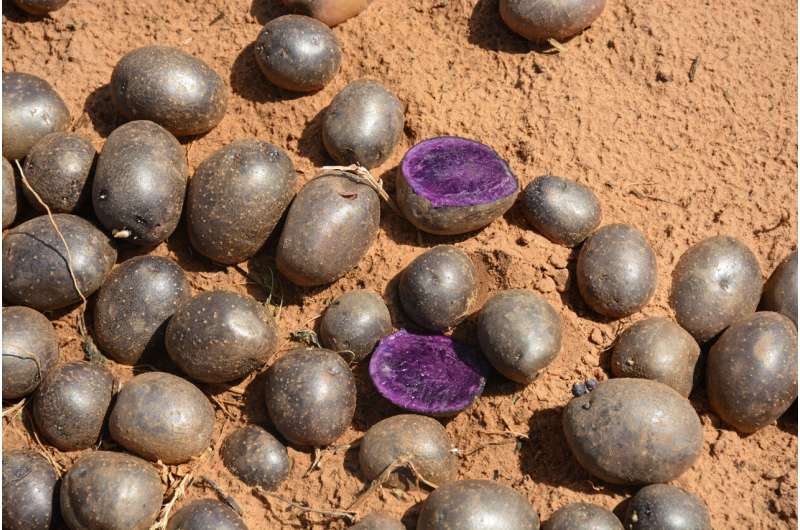
A purple-meated potato is one of the unique clones the Texas A&M AgriLife potato breeding program is growing in field trials near Springlake. Credit: Texas A&M AgriLife photo by Kay Ledbetter
New potato varieties bred by the Texas A&M Potato Breeding Program could enter the french fry market before long, said Isabel Vales, Ph.D., Texas A&M AgriLife potato breeder in the Department of Horticultural Sciences in the Texas A&M College of Agriculture and Life Sciences.
“We are quite excited about a light russet experimental potato clone that has a very special feature: a high percentage of starch and high gravity even under the very stressful high-temperature conditions in Texas,” Vales said. “I think the french fry processing market, for which Texas has not released any processing russets, is a possibility.”
The potato’s experimental identification is COTX08063-2Ru. The initial cross was made in Colorado and the selection made in Texas.
Historically, Texas has not been a player in that french fry market, Vales said, primarily because of the heavy competition from the Northwest, which is really strong in that market.
“But also, in Texas, we cannot get the high solids required for the processing markets. Out of all of the varieties and experimental clones we evaluated over time, none of them had a high gravity,” Vales said. “The experimental clone COTX08063-2Ru has a high specific gravity, even under high heat stress conditions in Texas, and makes very good french fries. This is the second year this clone is in the National French Fry Potato Trials.”
She said the amount of starch in potato tubers is the main factor determining a potato’s use. High solids or gravity means the potatoes are solid and dense. The potato yield is high, as is the starchy matter. High-starch potatoes are often used to make processed foods such as fries, chips and dehydrated potatoes. Potatoes with low to medium starch levels are frequently used for the fresh or table stock market.
Collaborating across state lines to reach numerous markets
Vales said the Texas A&M Potato Breeding Program is part of the Southwestern Regional Potato Cultivar Development Project, a multi-state project funded by the U.S. Department of Agriculture National Institute of Food and Agriculture.
In the U.S., Vales explained, there are four regional potato variety development groups involving 12 breeding programs in public land-grant universities and others within the USDA Agricultural Research Service. The regions are Northwestern—Washington, Oregon and Idaho; North Central—North Dakota, Wisconsin, Minnesota and Michigan; Northeastern—North Carolina, New York, Maine and Florida; and Southwestern—Texas, Colorado and California.
“In the southwestern region, we don’t have a USDA-ARS contribution like the others do,” she said.
Texas A&M University, Colorado State University and the University of California at Davis initiated the Southwestern Regional Potato Cultivar Development Project to meet the unique needs of the region’s potato industry, Vales said.
Crosses and original selections are made in Colorado and Texas, followed by regional evaluation trials in all three states and additional states in the western region—Oregon, Idaho and Washington. Some french fry and chipping clones enter national trials every year.
“In the U.S., most potato breeding programs are public,” Vales said. “The level of cooperation in potato breeding is unparalleled; potatoes developed by the Southwestern program are planted all over the U.S. and Canada. In the Southwestern region, we also evaluate potatoes developed by other regional programs.”
She added that while federal funding is the program’s main source for public breeding, other funds come from state departments of agriculture, national commodity groups like Potatoes U.S., foundations and in-kind support from growers. Additional funding comes from royalties derived from varieties released under plant variety protection, PVP, by the Texas A&M program.
“To obtain PVP, we have to declare that the potato varieties are unique, distinct and stable,” Vales said. “Seed growers planting PVP varieties must pay royalties. Texas A&M has been very successful in that regard. The amount we received this past year is more than $900,000, and part of that is reinvested in the program.”
Field day events introduce Texas A&M varieties, open market outlets
Vales said the trials in various locations across the state and field days are the best way to let growers and the industry know about the latest potato clones in the breeding pipeline.
“This year, we had 180 different clones in the field day display, representing fresh and processing market classes,” she said. “Within the processing class, we had chippers and french fry types; within the fresh, we had reds, yellows, purples, smalls and fingerlings.”
Around 48 people from various U.S. states and Canada attended the Springlake event. The attendees expressed interest in some clones and shared priorities and challenges with the Texas A&M Potato Breeding Team and other participants.
Early and advanced selected clones included in the field day are also evaluated in agronomic trials in Dalhart and the San Luis Valley, Colorado, as well as California around Bakersfield, South Central Valley and Tulelake, near the Oregon border.
Southwest region presents unique growing conditions, challenges for potatoes
She indicated that cooler nights favor higher yields and fewer tuber defects. Thus, in Texas, the yields get higher with elevation and latitude, which means “we typically obtain much higher yields and better tuber quality out of the Dalhart trials located in the Texas Panhandle.”
High temperature during the growing season is a major abiotic stress in several of the Southwestern Region production areas, Vales said. Heat stress can trigger physiological defects and negatively affect tuber yield and quality. Sensitivity to internal tuber heat necrosis, growth cracks, reducing sugar build-up, brown center, hollow heart and heat sprouts are assessed from field-harvested tubers.
“The potato varieties we develop come in different tuber sizes, shapes, skin and flesh textures and colors that fit different market needs,” Vales said. “For instance, we collaborate with Tasteful Selections, looking for clones with many small tubers. We are also growing fingerlings and bi-color potatoes. Recently, we developed a round russet with pink eyes and yellow flesh that was provided an exclusive release to explore new market opportunities.”
The Texas A&M Norkotah Russet strains continue to be the most popular, with 35 licensees in 12 states, she said. These are fresh-market russets. Two other fresh-market russets growing in popularity are the Reveille Russet, which doubled acreage from 2020 to 2021, and Vanguard Russet. The heat tolerance and long dormancy of Reveille Russet and Vanguard Russet are attractive features to growers across the U.S. and Canada.
Expanding potato markets beyond the Southwestern Region
Potato entries are evaluated in each state’s trials for numerous traits, including chip and french fry quality, Vales said. Top entries move to Southwestern for two years and Western Regional Trials for up to three years. Superior clones are released as new varieties. Also, Colorado, Texas and California participate in National Chip Processing Trials and the National Fry Processors Trials. Advanced selections are also sent to collaborators all over the U.S. and Canada.
Vales said the Southwestern Region Project shares breeding stocks and advanced selections with a dozen other states. Since the inception of the Southwestern Regional Potato Cultivar Development Project, 66 new cultivars and clonal selections have been released or co-released with other institutions. Colorado and Texas are responsible for 44 of those.
“These potato cultivars represent a substantial and increasing part of the national potato acreage and have significantly contributed to regional and national economies,” Vales said.
Several potato cultivars released by the Southwestern Region were listed in 2021 among the top 50 grown based on seed acreage in the U.S. Those developed in the region ranked second among the four regional projects, behind the Northwest and substantially ahead of the North Central and Northeast projects.
– – –
From Phys.org. Read here.
 Gary Secor, North Dakota State University Extension plant pathologist, talked about potato diseases at Northern Plains Potato Growers Association’s annual field day held Aug. 25, 2022, at Hoverson Farms near Larimore, North Dakota.